In this article
Plan an onboarding journey that distinguishes submitted information, review, acceptance, and usable payment activity.
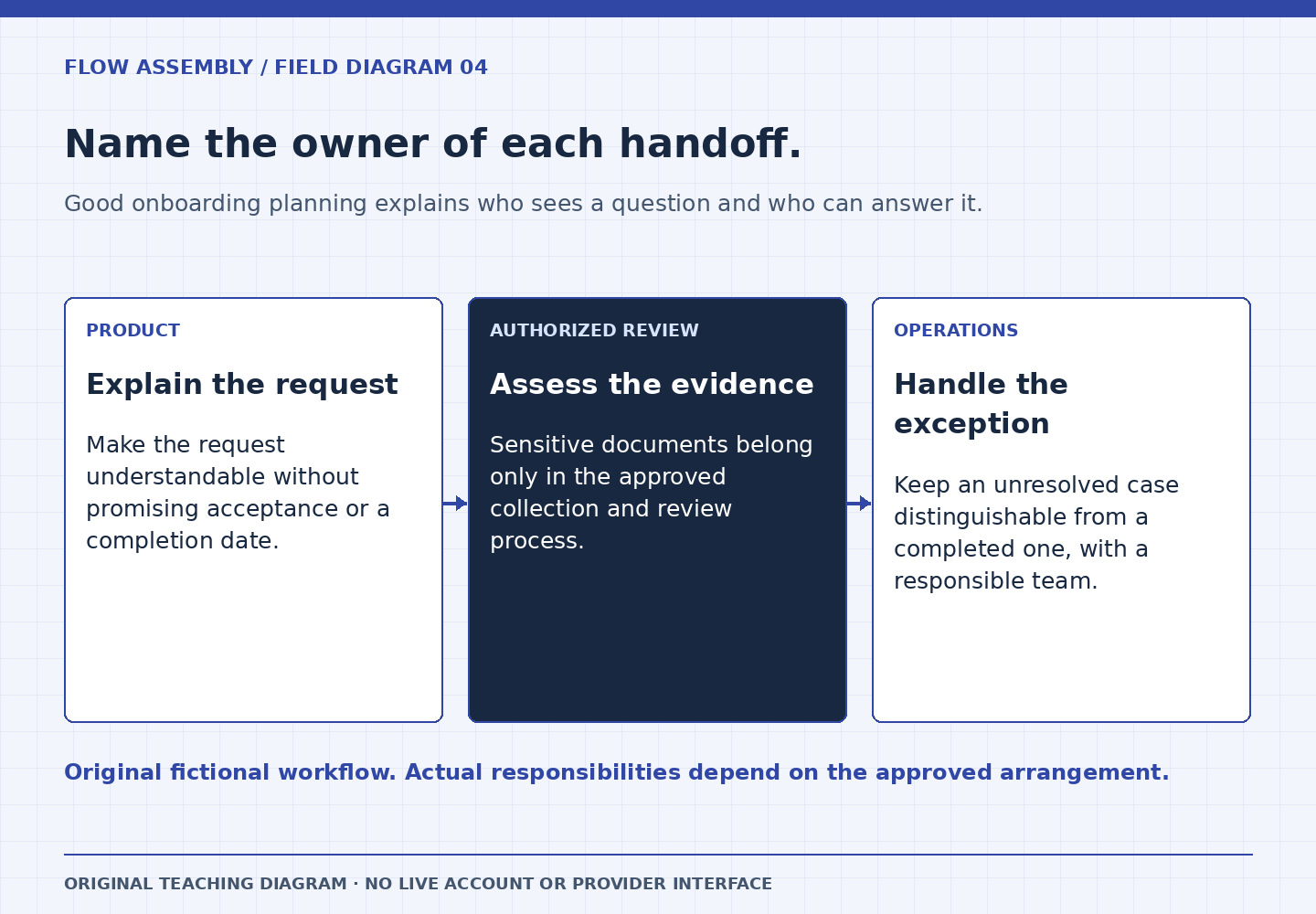
Onboarding is not finished merely because a form has no empty fields. A good journey tells the right person what is needed, preserves useful progress, and makes review or correction understandable. For a payment platform, the design also needs a clear boundary around who collects sensitive information and who records required acceptance.
Choose the collection route first
Moov’s integration and onboarding guide describes hosted onboarding and component-based alternatives. It specifies a terms-of-service Drop for merchant onboarding outside its hosted process. The choice affects implementation scope and data handling; do not design a custom form first and postpone those questions until launch week.
Write an onboarding responsibility map. For each information category, name the collecting interface, receiving system, person expected to provide it, and team that handles corrections. Prefer recording that an approved step was completed over copying the underlying information into every internal service. A support dashboard usually needs a status and an authorized next step, not a second repository of identity documents.
Separate milestones in the product model
Useful application milestones include invitation prepared, journey started, information submitted, review underway, correction requested, and intended activity available. These are editorial planning labels, not a claim about exact Moov API values. Map your labels to the current provider contract explicitly rather than inventing status strings and assuming the API will match them.
Every milestone needs a next action or an honest waiting explanation. “Something went wrong” gives a business owner no way forward. “The authorized representative needs to complete the remaining step through the approved onboarding route” is more actionable when that is what the evidence supports. Avoid exposing internal risk assessments or speculative reasons for a review.
Fictional worked example: the absent representative
A fictional platform called Meadow Appointments invites a studio manager to set up payments. The manager knows the studio’s public contact details but is not the person authorized to complete every business requirement. A poorly designed journey lets the manager enter guesses to clear the form. Meadow’s revised design instead identifies the required participant and supports an approved continuation route.
In the exercise, the manager completes the portion appropriate to their role and the authorized representative completes the remaining steps. The application records progress without claiming that submission equals approval. If the representative leaves before finishing, the studio sees a specific incomplete milestone rather than a false “ready to accept payments” banner.
The example is fictional and no invitation or account was created. Its lesson is about responsibility: the person operating a scheduling dashboard may not be the right person to make every assertion required for the payment relationship.
Plan corrections before the happy path
Ask what happens when a person mistypes a business detail, loses access to the invitation, or discovers that an existing record belongs to another entity. The recovery procedure should preserve the history of the original submission and avoid creating duplicate identities merely to restart a stalled screen. Route uncertainty to an authorized reviewer instead of teaching support to improvise a workaround.
Keep acceptance evidence distinct from ordinary form completion. Record the relevant event through the approved integration rather than asking a staff member to tick a box on someone else’s behalf. Your design review should identify where the current terms appear, how the appropriate person accepts them, and how the application recognizes completion without collecting unnecessary copies.
Onboarding checklist
- Choose an approved collection route before building custom fields.
- Name the responsible participant for each requirement.
- Separate information submission from review and activity availability.
- Provide a recovery path for interrupted or incorrect submissions.
- Keep identity material out of ordinary support notes.
- Preserve evidence of required acceptance through the approved flow.
- Assign ownership for duplicate or mismatched entity records.
Where this plan stops
The plan does not determine legal authority, satisfy verification by itself, or guarantee approval. Requirements depend on the intended activities and current provider rules. Have the responsible compliance and integration reviewers confirm the actual journey. The useful output is a set of explicit responsibilities and recovery paths that makes the onboarding experience easier to understand without weakening the checks behind it.