In this article
Build a test evidence log that states what a simulation proves and what still needs production review.
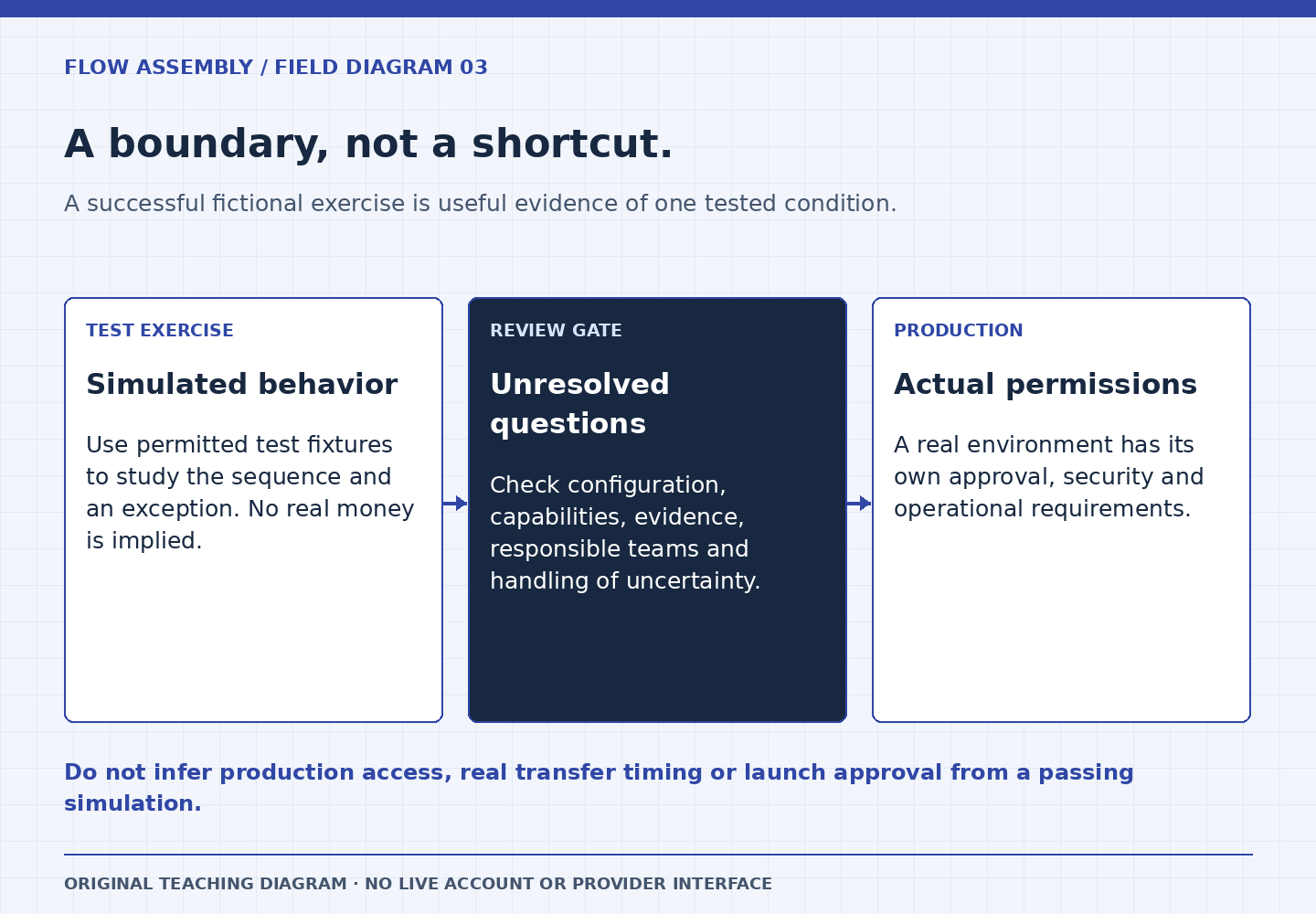
A green test result is valuable only when its meaning is clear. A simulation may prove that your application displays an error correctly without proving that a business is approved, an instrument is eligible, or a real payment will arrive on a promised schedule. Give every test result a boundary so that a successful demonstration cannot quietly become a launch authorization.
Identify what the environment supplies
Moov’s test-mode documentation describes simulated transfers without real money and automatically satisfied test capability requirements. It also identifies separate test access and test-specific credentials. These conveniences support integration work; they are not evidence that production prerequisites have been met.
Start your evidence log with the environment name, scenario purpose, application version, documentation reference, expected behavior, observed behavior, and remaining assumptions. If no execution occurred, label the row “planned” or “tabletop.” Never replace that label with “passed” because the design looks plausible. Readers need to distinguish a review discussion from an executed test.
Separate three kinds of evidence
First is interface evidence: the application shows the intended screen, preserves the user’s context, and provides an appropriate next step. Second is integration evidence: the application can parse a documented response and associate it with its internal record. Third is operational evidence: the people and systems responsible for a real exception know how to investigate and resolve it. A single happy-path demonstration rarely establishes all three.
For every simulation, write a sentence beginning “This does not establish…” Examples include actual funds availability, production account approval, real network behavior, or customer support response time. This is not pessimism. It prevents the next team from borrowing confidence that the experiment never produced.
Fictional worked example: a convincing demo
Imagine a fictional team at Harbor Sessions demonstrating a $45 payment flow. The interface quickly reaches its success screen in a planned test scenario. A product manager asks whether the team can promise customers the same speed after launch. The evidence log stops that inference: the scenario concerns screen transitions in a simulated environment, while production timing remains an open requirement.
The team creates three separate acceptance questions. Does the interface distinguish submitted from completed? Does the backend preserve the provider reference when a response is delayed? Does the support procedure explain how to investigate an unresolved payment? Those questions produce a more useful release discussion than a video of one smooth checkout.
No Harbor test was actually run for this article. The story illustrates how to classify evidence, and the dollar amount is fictional. Readers should use the current official test scenarios in their own authorized test environment rather than adapting production details into an educational exercise.
Prevent accidental environment mixing
Make environment identity visible in internal tools and machine-readable in configuration. Require a deliberate configuration review when moving a release between environments. A color banner is helpful to a human but should not be the only protection against sending requests to an unintended destination. Keep environment-specific identifiers and settings from being reused by convenience.
Review logs, screenshots, and exports before sharing them. Even a test project can contain real employee names or copied customer notes. Prefer synthetic fixtures and redact material that is unnecessary for the review. Do not paste secrets into tickets to prove that a credential was configured; record the configuration check without exposing the value.
Test evidence checklist
- State whether each item is planned, reviewed, or executed.
- Record the exact environment and application version.
- Use documented test fixtures for the selected scenario.
- Include delayed, failed, duplicated, and interrupted paths.
- Write down the limits of every successful result.
- Keep production approval and configuration checks separate.
- Assign an owner to each unresolved launch assumption.
Turn uncertainty into a launch question
When a result does not answer a production question, attach the question to a named owner rather than stretching the evidence. A clear unresolved item is safer than an unsupported “ready.” The official documentation can change, so preserve the review date and revisit relevant scenarios when the integration or API version changes. This article supplies an evidence framework, not certification that any application or account is ready to handle real funds.