In this article
Compare eligible payment routes against the actual deadline, cost, and exception-handling needs.
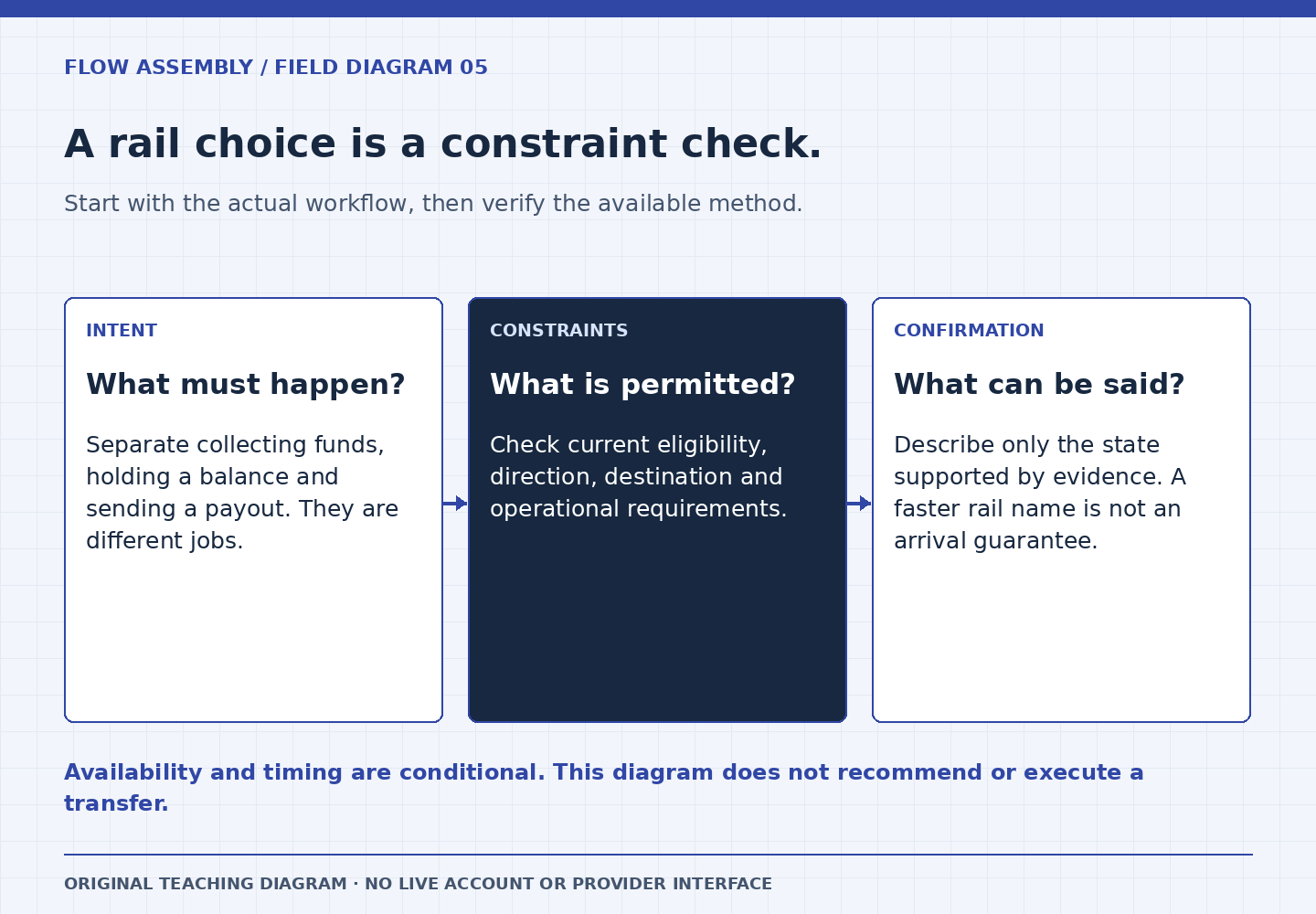
The fastest-sounding payment option is not automatically the right one for a workflow. A useful rail decision starts with the business job: who needs money, why, by when, and what happens if the movement cannot complete as expected. Write those constraints before comparing product names or building a default selection.
Start with eligibility, then preference
Moov’s money-movement overview describes transfers using a source and destination, with payment rails available according to the account and its capabilities. It also notes that not every use case qualifies for bank-to-bank ACH. Treat the available, approved routes as the starting set; a public feature list is not a routing entitlement.
For each candidate route, record the intended source, intended recipient, amount, currency, business purpose, and required arrival expectation. Then document the evidence that makes the route eligible. If that evidence is unavailable, mark the candidate unresolved. Do not award it a high score just because the headline description looks attractive.
Compare the whole operating cost
A decision record should include the quoted fee under the applicable agreement, funding needs, support burden, and the consequence of a failed or delayed payment. These are different kinds of cost. A low processing charge can still accompany an expensive manual exception process. Conversely, a higher charge may be reasonable for a narrowly defined urgent workflow without being the right default for every transaction.
Define the deadline in operational terms. “Today” needs a date, time zone, and meaning: submitted, accepted, available to the recipient, or confirmed by another system. Ask what evidence will establish that milestone. Do not convert a generic rail description into an unconditional customer promise, especially when funding or eligibility remains unresolved.
Fictional worked example: routine versus urgent
In a fictional marketplace, Juniper Repairs owes a technician $240. The ordinary workflow plans payouts in advance, while an exceptional workflow concerns an urgent same-day need. The team writes separate decision records instead of making the urgent route the universal default.
For the routine case, the team values predictable operations and a clear reconciliation process. For the urgent case, it first checks which routes are actually eligible for the recipient and amount, then compares the confirmed fee and timing conditions. If no eligible route supports the desired expectation, the interface says so rather than promising that a different button will solve the deadline.
The example does not select a real Moov rail or quote actual pricing. Its $240 figure simply makes the decision concrete. The important output is a documented reason for the choice and an honest explanation of what remains uncertain.
Make fallback a separate decision
A fallback can change cost, timing, destination behavior, or the user’s understanding of the transaction. Decide in advance whether the application may offer another route, requires a new selection, or must pause for investigation. An ambiguous response from the first attempt is not proof that it failed. Starting another movement while the original outcome is unknown can create a duplicate obligation.
Keep a distinction between “route unavailable before submission” and “outcome unresolved after submission.” The first may justify presenting another eligible option. The second requires recovering the original operation’s state before making a new payment decision. This boundary belongs in both the user interface and the operator procedure.
Rail decision checklist
- Write the business purpose and exact timing expectation.
- Limit comparison to eligible routes for the actual participants.
- Verify fees through the applicable commercial arrangement.
- Identify the evidence that will establish completion.
- Document failure, delay, and reconciliation responsibilities.
- Define when fallback needs a fresh user choice.
- Separate an unavailable route from an unresolved submitted payment.
Keep the decision reviewable
Store the decision date, assumptions, owner, and a reason to revisit it, such as a changed use case or recipient mix. Avoid permanent rules based on one successful example. The record is a practical product tool, not financial advice, a legal interpretation of payment obligations, or a guarantee of service. Current official documentation and the approved account-specific arrangement control what can actually be offered.